
Leon Schmitt · 23 September 2026
Examining Overlaps Between Public Procurement Issues and Data Disclosures from European Financial Institutions
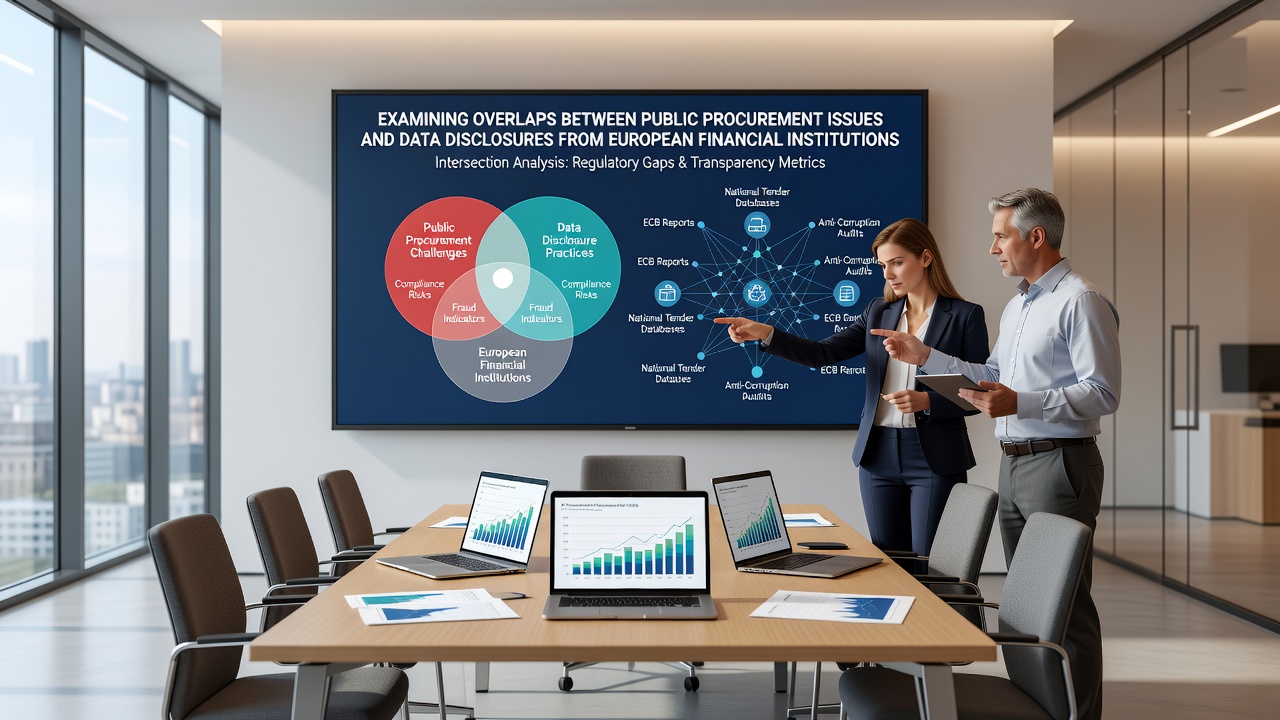
Public procurement processes across Europe generate vast volumes of contracts and supplier data while financial institutions must release detailed reports under rules set by the European Central Bank and national regulators, and observers note that certain overlaps emerge when procurement spending appears in bank disclosures or when contract financing triggers additional reporting requirements. Researchers have tracked these intersections through analyses of tender databases and banking filings since the early 2010s, with patterns becoming clearer after updates to the EU Public Procurement Directive in 2014.
Core Regulatory Frameworks Involved
European public procurement operates under directives that mandate transparency in tender awards and supplier selection, yet financial institutions disclose loan portfolios, risk exposures, and counterparty details through frameworks such as the Capital Requirements Regulation. When a bank extends credit to a company that wins a public contract, the financing arrangement can surface in both procurement notices and prudential reports, creating shared data points that regulators examine for consistency. Data from the European Commission shows that member states awarded contracts worth over 2 trillion euros annually in recent years, while bank disclosures reveal corresponding lending volumes tied to infrastructure and service sectors.
Analysts at the Organisation for Economic Co-operation and Development have examined how these reporting streams intersect, particularly in sectors such as construction and energy where large procurements rely on syndicated loans. One study released in 2023 highlighted cases in which delayed contract payments appeared as increased non-performing exposures in bank filings, prompting coordinated reviews by procurement authorities and banking supervisors. Such overlaps allow authorities to cross-check whether awarded contracts align with declared financial commitments, although differences in reporting timelines sometimes complicate direct comparisons.
Practical Examples from Recent Years
In Germany, several regional development banks disclosed project financing linked to public rail tenders, and subsequent audits revealed discrepancies between contract values listed in procurement portals and the drawdown schedules reported to the Deutsche Bundesbank. Similar situations arose in France where state-backed infrastructure projects appeared in both national tender registries and disclosures from major commercial banks under the European Banking Authority guidelines. These instances demonstrate how procurement issues, such as cost overruns or supplier changes, can manifest in altered risk metrics within financial statements.
Observers tracking developments in September 2026 noted that updated digital reporting standards from the European Securities and Markets Authority began requiring more granular tagging of public-sector exposures in bank reports, a change that aligns with ongoing efforts to improve procurement data portals managed by the Publications Office of the European Union. The alignment stems from joint working groups that identified gaps where contract modifications were not promptly reflected in lending disclosures, leading to potential mismatches in oversight.
Data Sharing Mechanisms and Challenges
Authorities have established channels for information exchange between procurement bodies and financial supervisors, including secure platforms that permit limited cross-referencing of contract identifiers with loan reference numbers. Yet technical differences persist because procurement systems often use standardized European codes while bank disclosures follow accounting standards that aggregate exposures by sector rather than by individual contract. The European Data Protection Supervisor has issued guidance clarifying when such sharing complies with existing rules, emphasizing anonymization techniques that preserve analytical value without revealing sensitive commercial details.
Studies conducted by academic teams at universities in the Netherlands and Sweden have quantified the frequency of these overlaps, finding that roughly 15 percent of large infrastructure contracts in sampled datasets correlated with specific entries in bank risk reports. Those correlations proved useful for identifying projects that experienced financing restructurings, which in turn affected procurement timelines. The findings underscore the value of integrated monitoring without implying any systemic problems.
Future Developments and Institutional Responses
European institutions continue to refine reporting templates to capture procurement-related financial flows more precisely, with pilot programs underway in several member states. The European Investment Bank publishes periodic overviews of its own lending activities that intersect with public tenders, offering another dataset for comparison. Industry groups representing financial institutions have participated in consultations aimed at standardizing identifiers that could streamline future cross-checks while maintaining confidentiality where required.
What's interesting is that advances in machine-readable formats adopted by both procurement platforms and banking regulators are reducing the manual effort needed to detect overlaps, allowing faster identification of inconsistencies that warrant further review. Data released by national statistical offices shows gradual increases in the volume of matched records over the past five years, reflecting broader adoption of digital tools rather than any shift in underlying activity levels.
Conclusion
The overlaps between public procurement issues and data disclosures from European financial institutions arise from intersecting regulatory obligations and shared economic activities, with multiple institutions documenting these connections through established analytical methods. Continued refinement of reporting standards and data exchange practices supports more coherent oversight across both domains, and evidence from regulatory filings and academic examinations indicates that such integration yields clearer pictures of contract financing and performance.